
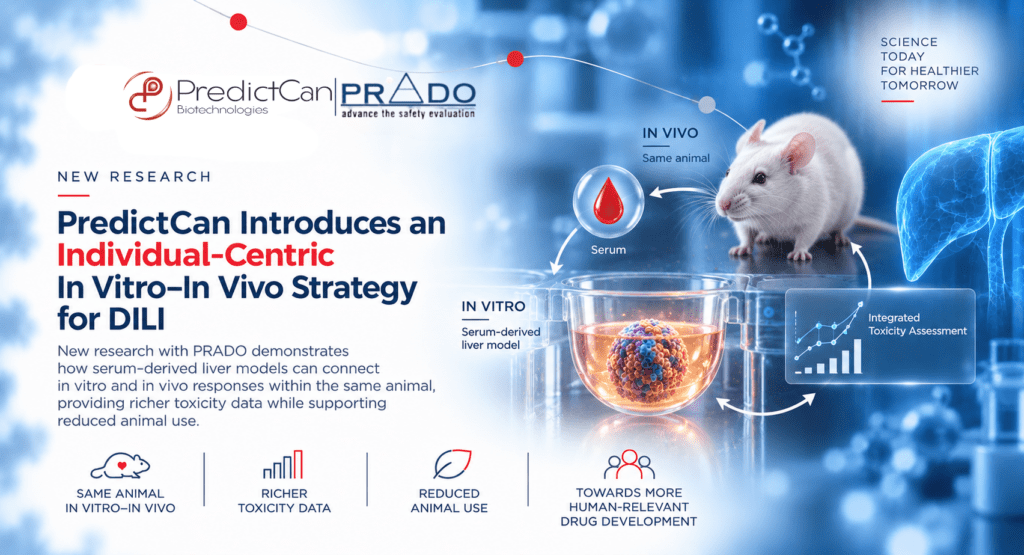
PredictCan Biotechnologies, in collaboration with PRADO Preclinical Research and Development Organization in India, has published a new study introducing an individual-centric approach to preclinical Drug-Induced Liver Injury (DILI) assessment.
The study applies PredictCan’s Cell Educating Technology™ to generate serum-derived educated rat liver spheroids from the same animals subsequently evaluated in vivo. This creates a direct connection between in vitro and in vivo responses at the individual level and provides a new way to investigate variability in drug-induced hepatotoxicity without increasing the number of animals required.
From Group-Based Toxicology to Individual Animal Responses
Conventional animal studies generally evaluate toxicity by comparing responses between treatment groups. While essential to preclinical safety assessment, this approach can mask interindividual variability, particularly when only a subset of animals develops a toxic response.
PredictCan and PRADO explored a different strategy: using serum collected from individual animals to generate a corresponding personalized liver model in vitro.
Each animal can therefore have its own in vitro biological counterpart, allowing investigators to compare how the same individual responds to a compound both in vitro and in vivo.
This approach preserves information that may otherwise disappear when results are analyzed primarily at the group level and provides an additional opportunity to investigate individual susceptibility to liver injury.
Detecting Toxicity and Biological Variability
The study demonstrated the ability of the serum-educated rat liver spheroids to detect hepatotoxic responses to compounds including diclofenac and bosentan.
Importantly, the models captured interindividual and sex-dependent differences in response and showed translational alignment between in vitro observations and in vivo toxicity biomarkers.
The approach also revealed subtle toxicity signals in situations where conventional clinical chemistry measurements remained within normal ranges, illustrating the value of adding an individualized in vitro layer to conventional animal studies.
More Information From Each Animal
The objective of this strategy is not simply to reproduce an animal experiment in vitro, but to increase the amount and quality of information generated from each animal used in a preclinical study.
Because individualized spheroids can be generated from serum, compounds can first be evaluated across the corresponding in vitro models. These data can help characterize variability, distinguish potentially toxicity-positive and toxicity-negative profiles, and guide subsequent investigations.
The study therefore opens the possibility of using the in vitro models as a pre-characterization layer alongside conventional in vivo toxicology, providing additional information on individual response without requiring a proportional increase in animal numbers.
A Practical Strategy to Advance the 3Rs
This approach was designed to complement rather than replace in vivo studies, providing a practical pathway toward the principles of Replacement, Reduction and Refinement.
Based on the study strategy, integration of individualized in vitro models could support a 50–70% reduction in animal use, while generating richer datasets from the animals that remain in the study.
It could also enable more targeted experimental designs, earlier identification of toxicity signals, and deeper mechanistic investigations focused on animals displaying different susceptibility profiles.
Connecting In Vitro and In Vivo at the Individual Level
The publication introduces a new way of thinking about the relationship between in vitro and in vivo preclinical studies. Rather than treating them as two independent experimental systems, PredictCan’s approach creates an individual biological bridge between them.
For pharmaceutical companies and preclinical safety organizations already conducting rat DILI studies, this means that existing workflows could potentially be enriched with an individualized in vitro characterization layer generated from the same animals.
The strategy reflects PredictCan’s broader ambition to move preclinical toxicology beyond population averages and toward individual-level biological understanding, while simultaneously improving predictive information and reducing reliance on animal experimentation.


