
applications
drug safety
The Challenge
Predict Drug-Induced Liver Injury Before Clinical Trials
Drug-induced liver injury (DILI) remains one of the leading causes of clinical trial attrition, regulatory restrictions, and post-market drug withdrawals. Yet predicting liver toxicity remains one of the greatest challenges in drug development because conventional preclinical models fail to capture the biological diversity of human populations.
PredictCan introduces a new paradigm in predictive toxicology by combining phenotypic personalized human liver models with artificial intelligence, enabling drug safety assessment across diverse patient populations before clinical trials begin.
The Solution
A Hybrid Platform for Predictive Toxicology
Human Biology Meets Artificial Intelligence
PredictCan-MPS™
Our proprietary MicroPhysiological System allows the generation of human serum-derived educated spheroids (hSES™) using our patented Cell Educating Technology™.
Unlike conventional liver models that represent a single biological background, PredictCan-MPS rapidly generates large cohorts of personalized phenotypic liver spheroids balanced for age, sex, and other clinically relevant characteristics. This enables drug safety assessment at the population level rather than in a single « average » model.
PredictCan-MIND™
PredictCan-MINDTM is a proprietary AI platform that integrates data generated by PredictCan-MPS™ and analyzes individual responses across an entire cohort.
This allows the generation of metrics including the severity and incidence of DILI at the cohort-level. These insights allows end-users to classify compounds according to their DILI risk, identify susceptible individuals, and high-risk population.
Beyond Prediction
Mechanistic Investigation
Uncover the Biological Mechanisms Driving Drug-Induced Liver Injury
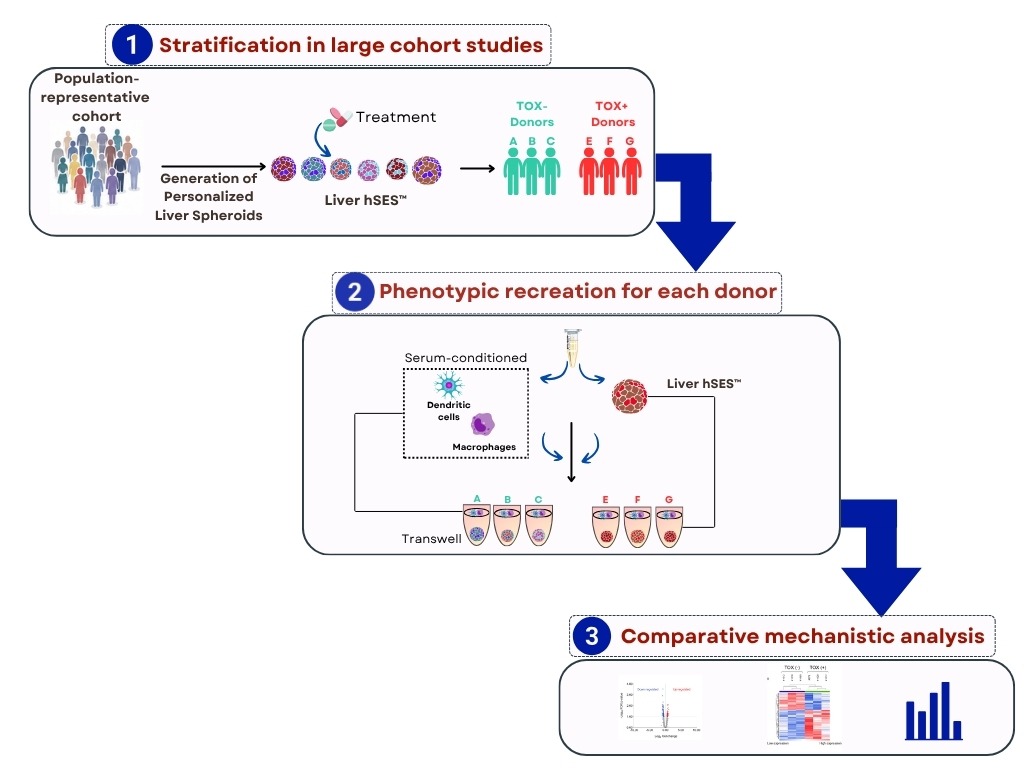
One of the greatest challenges in mechanistic toxicology is identifying the specific cell populations that trigge DILI as well as the molecular pathways responsible for initiating liver injury. This task is particularly challenging because susceptibility varies considerably between individuals, making these mechanisms difficult to reproduce using conventional preclinical models.
PredictCan overcomes this limitation by enabling comparative mechanistic studies across personalized phenotypic liver models.
Using our Liver hSES™ (Human Serum-derived Educated Spheroids), we first identify individuals who are susceptible, or resistant to DILI. The corresponding serum from these donors can then be reused to generate individualized liver models for in-depth comparative analyses.
This unique approach enables researchers to:
- Compare susceptible and non-susceptible individuals under identical experimental conditions
- Identify the cellular populations that initiate liver injury (including immune-mediated liver toxicity)
- Characterize the molecular pathways driving toxicity
- Generate mechanistic insights that support safer drug development
By combining individualized phenotypic models with advanced molecular analyses, PredictCan provides a powerful platform for moving beyond toxicity detection toward a deeper understanding of why toxicity occurs and who is most at risk.

Drug efficacy
The Challenge
Predict Anticancer Efficacy Across Patient Diversity
Patient Heterogeneity Remains a Major Challenge in Oncology
Cancer patients are biologically diverse, and their responses to the same treatment can vary considerably. Yet conventional preclinical models often rely on a limited number of standardized models that fail to capture this interpatient heterogeneity.
Moreover, a reduction in tumor cell viability does not necessarily reflect true therapeutic efficacy. At sufficiently high concentrations, anticancer compounds may induce target-independent cell killing (TICK), making it difficult to distinguish a genuine anticancer effect from non-specific cytotoxicity. If this effect is not considered during preclinical development, the therapeutic potential of a drug candidate may be overestimated, contributing to a lack of efficacy when translated into clinical trials.
The Solution
Individual-Centric Models for Predictive Oncology
Bringing Patient Diversity into Preclinical Efficacy Testing
Patient-Educated Tumor Models
Using our patented Cell Educating Technology™, PredictCan generates individualized tumor models conditioned by patient-derived biological environments.
Rather than evaluating efficacy in a single standardized biological background, our approach captures interpatient variability in drug response, enabling the same treatment to be evaluated across multiple patient-specific phenotypes.
This population-based approach reveals responders and non-responders, providing a more clinically relevant assessment of therapeutic efficacy.
TICK-Based Efficacy Assessment
PredictCan has developed and patented an analytical approach designed to distinguish true therapeutic efficacy from target-independent cell killing (TICK).
Before assessing a compound in patient-educated tumor models, its non-specific cytotoxic effect is characterized using a cohort of healthy educated spheroids. This provides a reference against which the response observed in tumor models can be interpreted.
By separating non-specific toxicity from tumor-specific activity, PredictCan provides a more stringent assessment of the true therapeutic potential of an anticancer compound.